
Strong reading comprehension requires students to think beyond the text, make connections, and draw conclusions. This is where inferential and critical thinking play a crucial role. Scarborough’s Reading Rope places these skills into the category of Verbal Reasoning. This strand supports the reader’s ability to understand implied meanings, recognize themes, and analyze an author’s intent. For these reasons, teaching inferences is essential for secondary English Language Arts teachers.
Verbal reasoning is the ability to think logically about language. Of course, understanding the language is a necessary first step. However, that is for a different post like this one or this one. Drawing inferences and evaluating information beyond surface-level understanding is what we’re here to talk about today. When students develop these skills, they move from passive reading to active engagement, deepening their comprehension and fostering lifelong literacy.
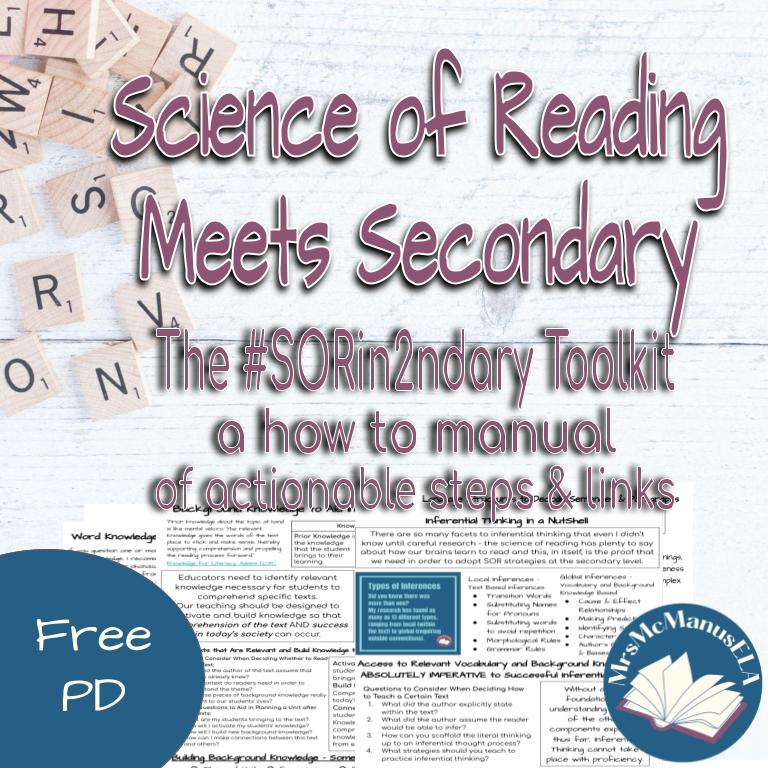
So let’s take a look at some ideas for building and practicing critical thinking skills. First, I would like to go through each level of reading and how these can build critical thinking stamina and support teaching inferences. These are activities that you can implement with any text. Check out my free #SoRin2ndary toolkit and planning kit for how to do it!
1. Using Word Level Interventions for Teaching Inferences
A Word Association Tournament is a fast-paced, engaging activity that helps students make connections between words, reinforcing vocabulary from a text while encouraging critical thinking.
Select a key word from the reading. Students take turns saying words that relate to it. Each word must logically connect to the previous one, forming a chain of associations that reflect their understanding of the text. If a student hesitates for more than the time frame you set, say five seconds, they are out, and the game continues until only one student remains or the class runs out of words.
This activity can be easily adapted for different texts and subjects, fiction or nonfiction. For example, students reading Night by Elie Wiesel could start with the word “survival” and build connections like “resilience”, “hunger”, “fear”, and “perseverance” to explore key themes.
2. Teaching Inferences with Sentence-Level Deconstruction
Sentence-level deconstruction is a powerful tool for teaching inferences and building critical thinking skills because it requires students to analyze how meaning is constructed within a sentence. By breaking a sentence into its grammatical components—such as subjects, verbs, phrases, and clauses—students learn to recognize the relationships between ideas.
Also, deconstructing complex sentences builds critical thinking skills by requiring students to evaluate and interpret multiple layers of meaning. When looking at super long or structurally intricate sentences, students have so much work to do. They must determine what information is important, what is just flowery description, and how different clauses interact with each other.
This process is so similar to the way they have to critically assess information in real-world contexts. Think about it: distinguishing fact from opinion and identifying bias in an argument are processes they will need forever. By engaging in sentence-level analysis, students practice seeing and evaluating connections. They recognize patterns and construct their own interpretations. These are skills that are essential for higher-level reading comprehension and academic writing–and they’re practicing it by studying grammar! Do you need some ideas for teaching grammar? I’ve got stuff for that!
3. One-Sentence Summary of Paragraphs – A Race to Teach Critical Thinking
Ask students to practice summarizing by condensing a paragraph into a single sentence to identify what is the most important information. They must focus on key ideas while maintaining accuracy. This is actually a really great strategy for critical thinking and reading comprehension, in general. However, it does also help in understanding paragraphs as well.
To make it happen, choose a key paragraph from a pivotal moment in the text that you’re reading, such as John Proctor’s confession in The Crucible by Arthur Miller. Challenge students to write a one-sentence summary that captures the main idea. You can have students read their sentences out loud, which also integrates speaking and listening, or submit them electronically. Then, have them compare the responses among themselves.
I recommend having students submit the sentences to you, evaluating them and, finally, assigning a few good ones back to your students to compare. You can also use this as an opportunity to discuss the elements of a good summary.
Now, let’s look at some whole text methods for teaching inferences from some of my teacher bffs. =)
4. Doodle Notes to Teach Inferences
Inference isn’t just a reading skill—it’s a thinking skill. And one of the most overlooked ways to practice it? Grammar. When students analyze how a word functions in context (Is run a noun or a verb? Is light describing or naming?), they’re using the same inferential thinking we ask of them in literature analysis.
To make this thinking stick, Alisha, from ELA Content Hub, loves using brain-based doodle notes. According to dual coding theory, combining visuals with text improves memory and engagement.
Doodle notes activate both sides of the brain, helping students retain concepts like parts of speech while encouraging them to slow down, observe closely, and draw conclusions—key components of inferential thinking.Want to try it with your students? You can grab Alisha’s free Parts of Speech Mini-Unit here and see how grammar can become a low-stress, high-impact way to build critical thinking.
5. Using short stories with post-it prompts
Use it or lose it? More like use it and keep developing it. While it doesn’t have the same ring, the latter is a good approach to inference skills. Lesa from SmithTeaches9to12 thinks that the more a student practices inference, the better!
One approach to teaching inferences is to include repeated practice using short stories with built-in prompts. Any story you might already use in your classroom, such as The Lottery, The Sniper, or The Black Cat, can work. It does take a bit of prep, but it’s always worth it (you can also grab the ready-made options Lesa has created here).
Once you’ve decided on a story, you can either edit a digital copy or use a more makeshift, but still effective, approach. The goal is to read the story and figure out where in the story a question can be included for students to dig below the surface or to read between the lines. Digitally, it means inserting a question and text box (whether it’s to be completed digitally or printed will be up to you). The low-fi approach is to write a question on a sticky note and place it below the section where the question would apply (the same spot where you’d have inserted a digital prompt). Then the student can answer the prompt, remove the sticky note and keep reading.
Teacher Tip: Print the questions/prompts on sticky notes by setting up a template to have them run through your printer so you don’t have to write out a class set. Another option is to put sticky notes on the students’ copies of the stories and then put the questions/prompts on the board or a slide and students can work through the story referring to the single source.
The point of the prompts is to slow students down and have them do the thinking in the moment. They’re literally and figuratively reading between the lines as they read the story.
For more ideas on incorporating inference skills practice in your classroom activities, check out this post about using grocery receipts and this one about using images.
6. A Debate Game That Sparks Critical Thinking
Claudia from Snappy Den Academy invented the game ARGUETROPIA to help in teaching inferences. Arguetropia is an immersive simulation game that challenges students to tackle real-world problems, develop strong claims, and defend their positions in lively debates. This interactive approach makes argument writing meaningful, helping students practice critical thinking, persuasive techniques, and collaboration—all while having fun!
ARGUETROPIA is an active learning experience that shifts students from passive writers to confident debaters.
7. Close Read Coloring Stations for Teaching Inferences and Building Critical Thinking
How can you get students to closely analyze images, word choice, and figurative language from a text in an engaging way?
Caton Conde from @theenergeticeducator suggests close-read coloring stations! Close-read coloring stations, like this one for The Pedestrian, incorporate images for small sections of text for students to color and design in conjunction with their analysis. Images are so important for teaching inferences because they help visualize concepts, clarify meaning, and make information more accessible, especially for language learners.
To run a close-read coloring station lesson, select short quotes or paragraphs from any text–even a speech or poem would work–that includes words, images, or language that is worthy of analysis. Place these quotes around the classroom at 5-6 stations.
For each quote station, students make an inference about the author’s purpose for that language by zooming in on key words and images through guiding questions, and then zooming out to the central idea the author develops through that language.
After discussing, students color and caption a corresponding image from the section. When they have looked closely at 5-6 images from the text, students are ready to conduct their small group discussion. They look for similarities between the images and language and patterns the author might have created through this word choice or imagery and make inferences about the purpose. This has been especially helpful for teaching inferences with profound moments from texts like Of Mice and Men and Fahrenheit-451.
The best thing about this activity is that it is completely student-driven! Teachers should circulate to clarify and ask prompting questions, but students do the heavy cognitive lifting in pairs or groups!
Caton has used (and reused) this close-read coloring strategy in many different units and with many different texts in her classroom. Check out all of the uses for it with Romeo and Juliet at her TPT store!
8. Read the Room – Inferencing the Easy Way
Students infer all the time, but they often don’t realize it. They “read the room” at home when they sense their parents are upset or at school when the principal frowns at them for littering. They notice when something is off with their friends or teachers. In these moments, they gather evidence, analyze it, and draw conclusions. If they can infer in real life, they can apply those same skills to reading.
But how can we teach this skill? Teri Gruenwald, of Intentional Teaching and Learning acts out scenarios by entering the room angry, excited, or disorganized, using body language and actions to show your emotions. Ask, “What’s going on? What do you notice? Why do you think that?” Students love watching their teacher be dramatic, and these discussions help them connect observable clues to logical conclusions. This builds a foundation for making inferences and shows that they already use this skill in everyday life.
From there, introduce short passages or picture books with rich clues—words that set a mood, reveal character reactions, or hint at future events. Model how to identify these clues with a think-aloud, ask guiding questions, and let students practice. The resource, “Making Inferences Task Cards – Reading, Evidence & Questions – for Middle School,” offers 10 printable and digital task cards with excerpts from public domain novels and guiding questions to help students make inferences. It’s an engaging, hands-on activity that students enjoy, and with practice, you’ll see results! While you’re at it, check out this What We Do When We Read: Teach or Review Reading Strategies for Middle School resource from Teri too. Metacognitive Logs are another great strategy to teach reading response, as well.
9. Hexagonal Thinking for Teaching Inferences and Critical Thinking
The concept of hexagonal thinking isn’t new but if it is new to you, here’s the gist. Students match hexagons together like they are pieces of a puzzle. These can be pre-made, by the teacher, with concepts from the text that you’re reading, or blank and students fill them in on their own. After matching so many of the hexagons together, students explain their thinking. You can direct them to choose one or two connections and write about how those two concepts go together. If you or your students are new to the concept, you can try something like this. It has students thinking critically about the cause and effect of social emotional learning scenarios.
10. Thinking Critically as Pre-Reading
Since spring has finally arrived, what better way to combine critical thinking and poetry than with a poem about blossoming? As teachers, we often provide the text we’re studying and then deep dive into the finer details… but what if we flipped that? Emily, from Pagecraft ELA, uses deconstructions to promote critical thinking as extended pre-reading tasks. In this activity, she gets her students thinking deeply about From Blossoms before they even read it. They break down key elements like setting, color, imagery, and emotion—basically all the ingredients that give poetry its power, and each mini-lesson gets them making connections, asking questions, and really thinking about how these pieces might fit together. The hexagonal thinking map at the end pulls everything back into place. By the time they actually read the poem, they’re already primed with big ideas and a deeper sense of curiosity, which makes for way more meaningful conversations. Blossoming in every sense of the word!
Check out this freebie from Emily @pagecraftela, too, and maybe get the kids to stop saying 6-7? Ha!
However you choose to practice inferencing and critical thinking, remember that there are so many types to consider. We tend to focus on global inferences — the ones that we make across an entire text and from one text to another. BUT even the little things like understanding transition words and knowing who a pronoun refers to are inferences that skilled readers make, without even realizing it, so we HAVE TO TEACH those things! If you haven’t already, read this post about understanding the difference between global and local inferences. And don’t forget to download my FREE #SoRin2ndary Toolkit and Planning Resource.
Do you have a great idea for teaching inferences? Share it in the comments!


Leave a comment