
My department is tiny. There are only ten of us for grades 6-12. We meet pretty regularly though and I love it. Every time that we meet, we do a little bite-sized PD organized by one of us. This month is my turn to present and I’m really excited about.
I’m leading a quick 15–20 minute session this week and I thought I would take the opportunity, here, to jot down a little preview.
At first, I was going to share my syntax building card sorts but my department chair asked me to talk about the quickwrite process that I use with my students. Apparently, our curriculum coach saw me do it during a walkthrough a while back and suggested that it could be a way to get all of the grade levels writing a little more.
So now, my plan for my bite-sized PD is to open with my colleagues doing a short quickwrite using a passage from Stephen King’s On Writing. In the excerpt, he talks about the power of active voice verbs. I’ve actually used this excerpt with my students before and it is a funny way to get them thinking about the words they choose and how syntax can shape meaning. It kind of goes over my students’ heads though and that makes it a really good representation of what the quickwrite process can do in our classrooms.
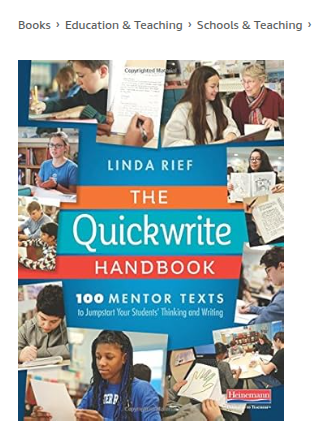
I’ve been using Quickwrites with my students since I saw Linda Rief speak at a professional development conference several years ago. It’s a simple idea, but it takes structure and routine to really work. Here’s how it goes:
- Students read a mentor text once to themselves. Depending on the mentor text and their reading level, it might be a struggle for them. I ask them to embrace the struggle so that they can see what expert texts look like.
- I read it aloud so they can hear it fluently. I tell them that it should make a little more sense, which shows the power of syntax and fluency.
- Students steal a line or choose a starting point.
- They write for 3–5 minutes.
This routine gets students interacting with mentor texts and writing almost every day. One thing that Linda Rief made me realize is that writing is hard because students are afraid of sounding silly or not knowing what to say. They need to become comfortable with the struggle. Whenever I introduce the quickwrite process to them I make “don’t think, just write” my mantra. Writing is thinking but sometimes we think too hard.
That’s why we do quickwrites so often. By the time my students are finally comfortable writing, they’re not copying things word for word, they’re not worrying about what they’ll write next. Hopefully, they’re getting words on the paper so that they can edit and revise and make their work better in the process. I’m a really big fan of this method and have been using it for several years now. If you’d like to read more about it, check out Linda Rief’s book.
After I explain all of this to my colleagues, using a text about grammar, I’ll go into the card sort activity that I had originally planned to share with them. This syntax-building activity was born from the challenge of teaching grammar in context.
While we know teaching grammar in context is the way to go, sometimes the perfect mentor sentences just don’t exist in the text we’re reading. For me, that was The Outsiders. So I wrote my own sentences. This gives students a hands-on way to practice identifying, and, more importantly, manipulating phrases and clauses while keeping the context of something engaging and familiar.
It does double-duty by helping to reinforce grammar concepts but also aiding in comprehension. This is another thing that my students do so routinely that it is easy for them, now. But it always challenges them to think and write bigger, better sentences.
Check out this free version or grab one for a text that you’re going to be reading in the next few weeks.


Try both of these ideas right along with my own department this week: a Quickwrite and a syntax card sort. It’s a short session, but the goal is to leave with practical tools that can be used immediately with students, ways to make writing and syntax feel natural, interactive, and even fun.


Leave a comment