

In order to fully comprehend any piece of literature, students need more than just an understanding of plot, characters, and themes—they must also have a solid grasp of grammar and syntax. Grammar is the foundation that allows students to analyze how sentences are structured, how ideas are connected, and how language works to create meaning. It isn’t part of Scarborough’s Reading Rope for nothing.
One of the most effective ways to teach grammar is through the context of what you are reading. I am in the midst of teaching The Outsiders by S. E. Hinton. So let’s take a look at the opportunities that students have to explore syntactical concepts in a meaningful, engaging way, directly tied to the narrative that we are analyzing. By weaving grammar lessons into literature study, students not only develop the technical skills necessary for comprehension but they also have the opportunity to deepen their understanding of the text as well.
Here are six grammatical concepts that you can seamlessly integrate into your teaching of The Outsiders by S. E. Hinton.
1. Sentence Variety: Simple, Compound, and Complex Sentences
One of the simplest yet most effective ways to analyze syntax in The Outsiders is by examining sentence structure. The mix of simple, compound, and complex sentences in the book make it a really great grammatical concept to teach during your reading of it.
Start by teaching the concept of sentence types and looking at various examples within the text. This is a super basic grammatical concept but it is one that is so necessary. As sentences become more complex, comprehension, obviously, goes down. We have to teach students how to navigate these sentences.
Grab my Mentor Sentences for reinforcing Sentence and Phrase Types with The Outsiders Here.
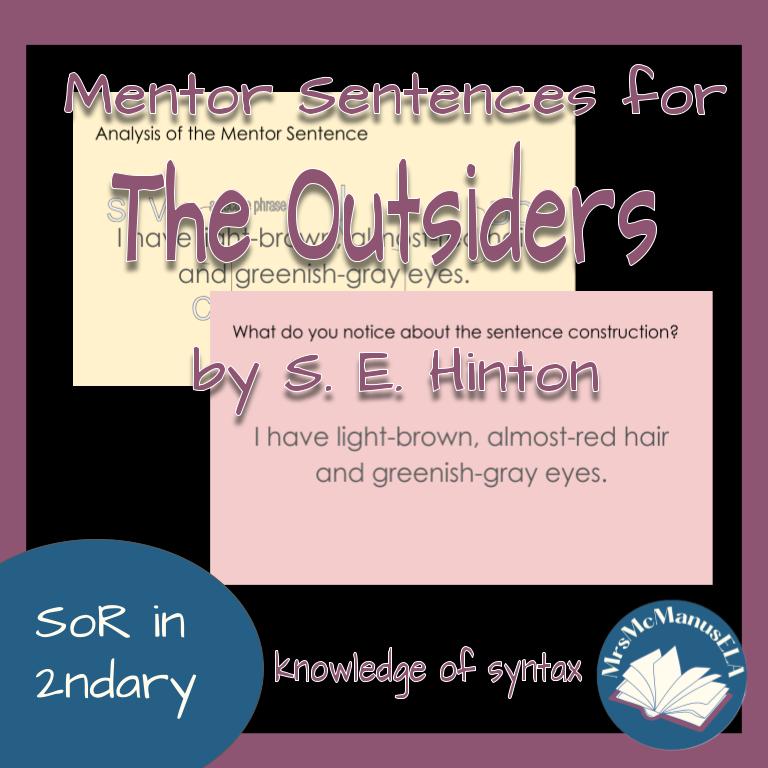
After teaching the concept and using mentor sentences from the text, you can dive even deeper by taking a look at the different purposes for each type of sentence within the story. Many of the simple sentences in the story create tension, while the compound and complex sentences allow for deeper reflection. For example, “I lie to myself all the time. But I never believe me,” conveys Ponyboy’s emotional conflict through short sentences with a ton of impact.
2. Point of View and Pronoun Usage
Pronoun use is something that seems super simple but plays such a huge part in comprehension. A reader’s ability to track the pronoun back to its antecedent falls into their inferential thinking capabilities. For that reason, even if point of view and pronoun usage seems incredibly elementary to you, it is still something that you should point out as you are reading any text.
In The Outsiders, Ponyboy often refers to characters using pronouns like “he,” “they,” or “we,” and students can be asked to identify the antecedents of these pronouns to ensure clarity in their writing. For example, a sentence like, “He didn’t want them to know how scared he was,” challenges students to infer which character “he” refers to, based on the surrounding context. This encourages close reading and inference skills as students must pay attention to the flow of conversation or action in the text to correctly identify antecedents.
One really easy way to teach this is to ask students to rewrite passages from the novel, making sure each pronoun clearly refers back to its specific antecedent. Another cool way to think about pronoun use is to have students rewrite a passage from another character’s perspective. This not only hits on grammatical concepts but literary standards as well!
3. Appositive Phrases and Clause Types
Appositive phrases in The Outsiders provide an excellent example of how descriptive details can be embedded directly into sentences without disrupting the flow. For instance, “Darry, the oldest, was smart beyond his years” gives readers additional information about Darry’s character in a smooth, concise manner. Teaching students how to use appositives enhances their ability to add clarity and detail to their writing.
You can absolutely leave it at just teaching appositives. However, you can go a step further and teach the different types of dependent clauses as well. Appositives are just one type. However, relative clauses and adverb clauses play a really big part of the story. Make sure to grab my mentor sentences!
I highly recommend The Writing Revolution method of sentence expanding to teach appositives and clause types. You can do this with ideas from the Outsiders or any other concept that your students are learning.
For example, start with a simple sentence like “Ponyboy met Cherry.”
Then, ask: where?
Ponyboy met Cherry at the drive-in.
Then, ask: when?
Ponyboy met Cherry at the drive-in on Friday night.
Then, ask: how?
Ponyboy met Cherry at the drive-in on Friday night when Dally was giving her a hard time.
Seriously, check The Writing Revolution out! It is gold. (Do you see what I did there?)
4. Dialogue Mechanics and Punctuation
With a novel so rich in dialogue, The Outsiders offers plenty of opportunities to teach correct punctuation and quotation rules. The proper placement of commas, periods, and dialogue tags is essential for clarity and flow. For example, in the line, “’Stay gold, Ponyboy. Stay gold…’ The pillow seemed to sink a little, and Johnny died,” the use of ellipses and commas adds emotional weight to Johnny’s final words. Teaching dialogue mechanics helps students develop more polished and effective dialogue in their own writing.
Personally, I do this while we use evidence from the text in our literary analysis essays about the theme of the story but the opportunities are pretty endless.
5. Parallelism and Repetition for Emphasis
Parallel sentence structures and repetition appear throughout The Outsiders to underscore key themes and emotions. These are a great opportunity to teach this advanced grammatical concept.
In moments of tension or reflection, Hinton repeats phrases or structures to build rhythm and emphasize character experiences. For instance, Ponyboy’s repetition of “I remembered” during his reflections adds depth to his emotional state.
Understanding parallelism allows students to see how sentence structure can highlight a character’s emotional journey and thematic elements in the text.
6. Ellipses and Dashes for Pauses and Interruptions
Ellipses and dashes are used throughout the novel to create natural pauses and interruptions in dialogue and thoughts, mimicking the flow of real speech. For example, when Ponyboy speaks to Johnny, saying, “You’re not going to drop out,” the dash captures the abruptness of the exchange. Teaching these punctuation marks helps students control the rhythm and emotion in their own writing, particularly in dialogue
Whatever grammar concepts you choose to teach during your reading of The Outsiders by S. E. Hinton, you’re golden. Ha!
Happy Reading!


Leave a Reply