Let’s be honest, most of us were not trained to teach kids how to read. We know all of the reading strategies, though. And you’ve probably taught your students to use them: make predictions, visualize, ask questions, and summarize.
I still hang anchor charts with sentence starters for inferences or text-to-self connections.
And doing all of this… we call it reading instruction.
But here’s the problem: reading strategies aren’t the same thing as reading skills. And if our goal is to actually improve comprehension, especially in a secondary classroom, it’s time to rethink what we’re doing.
It’s time to ditch the strategies, or at least think BEYOND the strategies and start teaching the real skills that make comprehension possible. If our goal is real, lasting comprehension, we need to stop teaching kids to look like readers and start teaching them the actual skills they need to become one.
Reading strategies aren’t enough.
So What’s the Difference Between Skills and Strategies?
There’s a lot of debate around these terms. But for the purposes of this conversation (and an upcoming professional development session that I’m so excited to share with you), here’s how I am defining them:
- Skilled Reading is the automatic ability to comprehend written text, something students do without really thinking or putting in any effort (after we teach them, of course)
- Reading Strategies are the actions readers take to help them when they’re stuck. These might include rereading, visualizing, or asking a question. And they ARE useful, but only after the foundational skills are in place.
The problem? Many secondary classrooms spend weeks or even months on isolated strategy instruction, like “find the main idea” or “ask a question,” without ever addressing the underlying skills that make comprehension possible.
As literacy researcher Kristen Cunningham writes:
“We treat comprehension strategies as though learning them is the point.”
Learning the strategies is not the point.
Enter Scarborough’s Reading Rope
The Science of Reading research gives us a much more complete and useful framework: Scarborough’s Reading Rope.
It’s not a list of tricks. It’s a model of how skilled reading develops, woven together through two strands:
- Word Recognition – decoding, sight recognition, phonological awareness
- Language Comprehension – vocabulary, syntax, background knowledge, text structure, and more
When these strands are tightly woven through systematic instruction, students become fluent, confident readers.
But when we skip over those threads and rush to “find the theme” or “make an inference” — we’re expecting complex comprehension to happen without the cognitive tools needed to get there.
What to Do Instead: Focus on Foundational Language Skills
It’s not that strategies are useless. They aren’t! I use reading strategies when I come up against a text that requires background knowledge that I don’t have or uses complex sentence structures that I am not used to. Strategies aren’t useless, they’re just not where instruction should begin. Instead, focus your ELA teaching on explicit, skill-based instruction using Scarborough’s strands as a guide.
Here’s what that looks like in action:
Build Background Knowledge
Before a novel, introduce students to the time period, geography, and social context. A short text set, research project, or multimedia exploration does so much more for comprehension than just, simply telling the students to “preview the chapter.”
Teach Vocabulary with Structure
Instead of only focusing on a handful of text specific words, right before you read, introduce Tier 2 words with context clues, definitions, and meaningful use systematically. Nagy and Scott (2000) found that comprehension can only happen when the reader knows 90-95% of the words. That is a lot of Tier 2 words. If we are only teaching the 6-8 text specific (probably academic) words, we’re not teaching enough.
Integrate Syntax and Sentence-Level Work
Use mentor sentences from your texts to teach things like appositives, prepositional phrases, and complex constructions. Or let your grammar work do double duty by using sentences that help students understand the plot points.
Focus on Text Structure
Teach how informational and literary texts are organized, and how structure shapes meaning. Students can’t summarize well if they don’t understand how the text was built. This also aids in their ability to make inferences and use verbal reasoning.
Make Time for Fluency
Especially for students reading below grade level, fluency isn’t optional. Practice it regularly with engaging passages that are on their current reading level. Don’t resort to popcorn reading a super complex text. Instead, integrate these fluency book recommendation blurbs or a knowledge building text set. Again, on their level, though. Trying to muddle through a text that they aren’t equipped to read won’t build fluency.
Bottom Line: Teach Readers, Not Reading Tricks
Scarborough’s Rope reminds us: reading comprehension isn’t a trick that can be attained through strategies, it’s a result of many skills intertwined. Don’t teach students how to use bandaids when they don’t have the foundations.
Reading is what happens after we’ve built word knowledge, taught syntax, modeled fluency, and connected content to the real world.
So let’s move beyond worksheets filled with empty predictions and vague connections. Let’s stop pretending that circling the main idea is the same as understanding a text.
We have to ditch the strategies and finally teach the skills that lead to real, lifelong reading comprehension.
Do you want to know more?
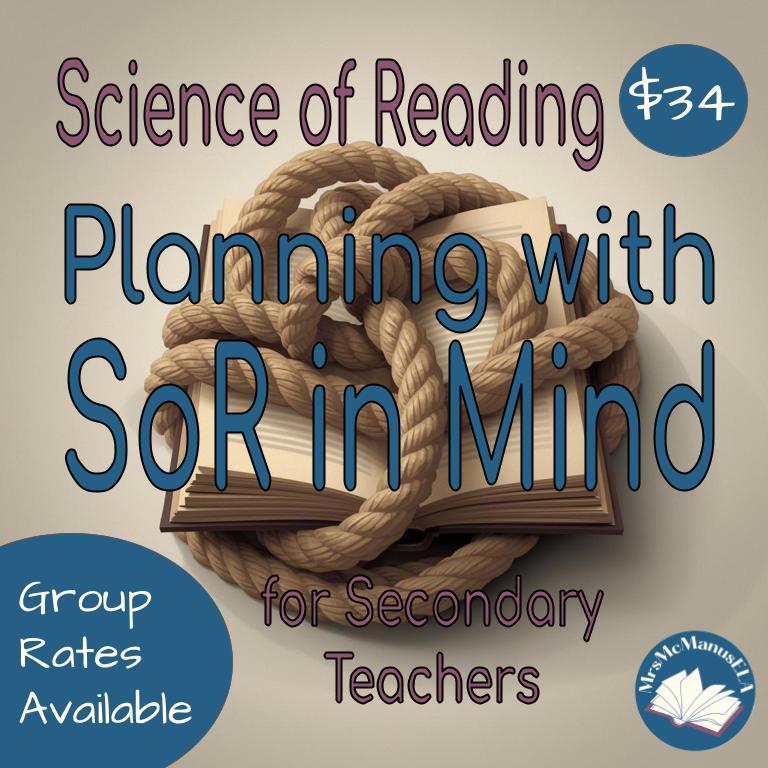
Check out my Planning with the Science of Reading Research in Mind Course, where I unpack how to shift your reading instruction using Scarborough’s Rope as a planning tool. You’ll walk away with actionable tools to restructure your units and lessons for real reading growth.


Leave a comment